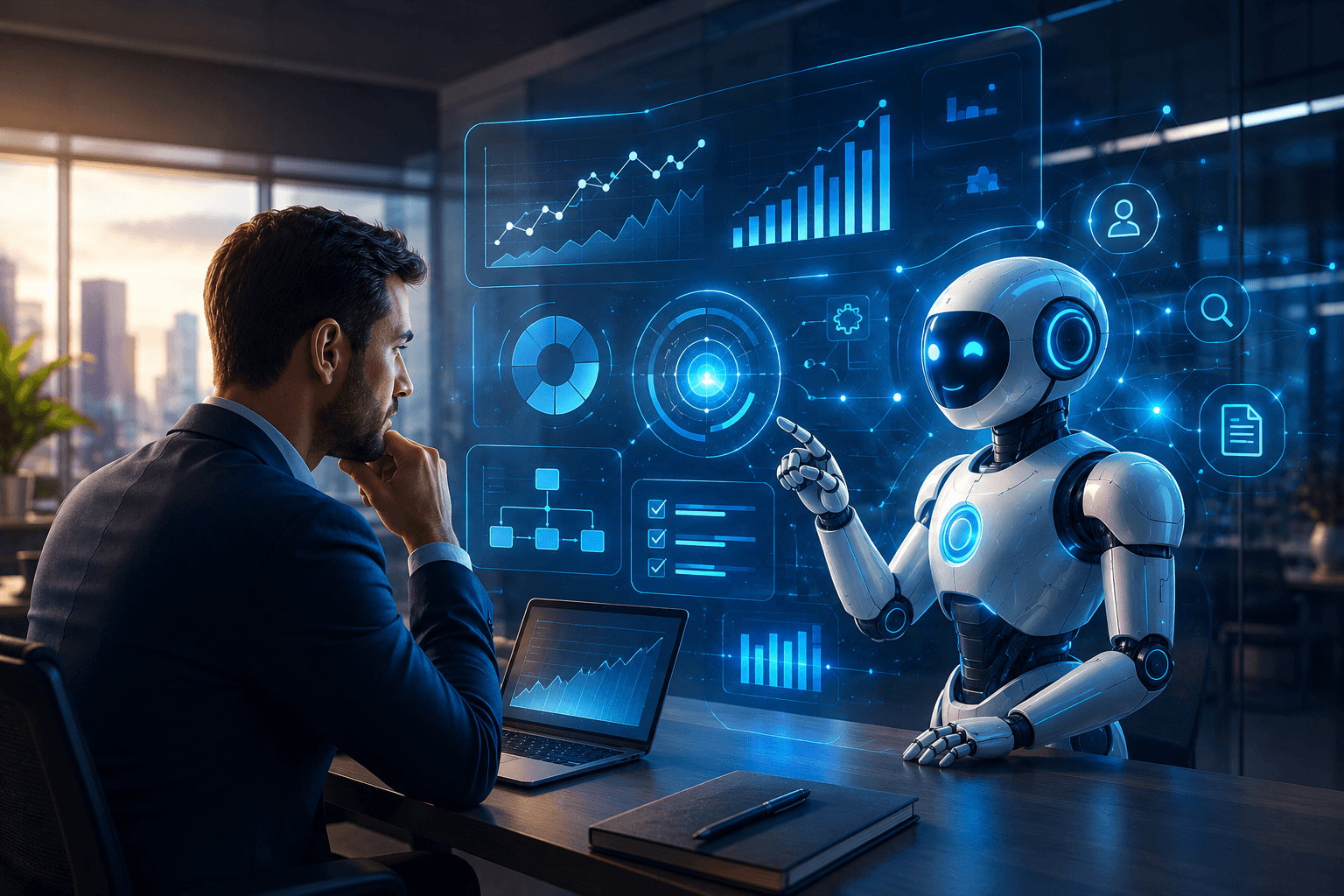
AI will not just replace jobs, it will change the value of professional experience.

Arthur Frota

Over the past few months, I have noticed a quiet shift happening inside companies. Frankly, I think few people have realized its scale yet.
For a long time, most company structures were built like a pyramid. A few senior professionals at the top, many junior professionals executing operational tasks at the base.
This made sense. For decades, companies needed a massive workforce to organize information, update systems, build presentations, produce reports, execute repetitive tasks, and operationalize processes.
The problem is that artificial intelligence is starting to take over this exact operational layer. This deeply changes the logic of the workforce.
AI is starting to alter the operational structure of companies
Recent research has begun to show clear signs of this shift.
Primary SourceA study by Anthropic identified that AI tools already significantly impact tasks associated with entry-level professionals and repetitive activities linked to writing, analysis, programming, and administrative operations. (Access: anthropic.com/research/economic-index)
The World Economic Forum report showed that roles tied to repetitive and administrative tasks are among the most exposed to automation in the coming years, while analytical, strategic, and coordination skills gain growing importance. (Access: weforum.org/reports/the-future-of-jobs-report-2025)
In practice, this does not necessarily mean the end of junior professionals. It means the relative value of purely operational tasks is starting to decrease rapidly.
The issue is not just replacement
I believe there is a superficial reading of this topic. Many people reduce the discussion to: "will AI replace jobs?"
But the real transformation lies elsewhere. AI is changing the value of experience, the type of professional required, the operational structure of companies, and the logic of team growth.
AI does not just eliminate work. It alters the composition of work. This distinction completely changes how we must think about career and professional development.


The market is starting to value context more than operational execution
This is perhaps the most important point. For a long time, professionals grew by executing repetitive tasks until they built enough repertoire to make bigger decisions.
But a shift is happening now. AI tools can already build presentations, summarize meetings, generate analysis, code parts of systems, structure research, and automate workflows.
And this creates an important question: if intelligent systems execute a significant share of operational tasks, what becomes the true human differentiator?
In my view, the human differentiator becomes:
Context
Judgment
Repertoire
Strategic thinking
Adaptation
Leadership
Decision making
Coordination
In other words: characteristics usually associated with more experienced professionals.
We might be moving toward leaner, more senior structures. With fewer people executing repetitive tasks, and more people capable of operating complex systems.
The challenge for early-career professionals will be greater
This is perhaps one of the most delicate parts of this transformation. Historically, more operational positions served as an entry point for learning.
But if part of these tasks begins to be absorbed by AI, the traditional path of professional development also changes. And this creates an important challenge: how to build repertoire without going through the operational stages that used to build experience?
Honestly? I do not think we have this answer completely yet. But I believe some skills are starting to gain a lot of value in this scenario:
critical thinking
clear and precise communication
analytical capacity
rapid adaptation to new tools
deep business understanding
coordination of intelligent systems
contextual intelligence
Because perhaps the professional of the future will need to learn less about executing repetitive tasks and more about operating alongside intelligent systems. If you want to understand more about how to develop these skills, the World Economic Forum published a practical guide on professional reskilling for the AI era.
AI does not eliminate human importance
Despite all the automation, I believe companies will continue to depend deeply on people. But perhaps they will depend on different people. Less focused solely on repetitive operations and more focused on direction, context, culture, decision making, leadership, and coordination.
Because at the end of the day, AI still lacks accountability, long term vision, cultural reading, political capability, or strategic awareness. And perhaps precisely because of this, more complete professionals will become even more valuable.
The future of work will probably be hybrid
In my view, the future will not be humans versus AI. It will be humans plus intelligent systems operating together.
And perhaps the strongest companies of the next decade will be those capable of building this integration in the best possible way. Not just adding AI to the operation. But reorganizing the entire company around this new operational logic.
I wrote more about this operational reorganization in the article on operational intelligence as the next moat for companies. Worth the read.
We are still at the beginning
Honestly? I think we are still very much at the beginning of this transformation. Most companies are still using AI as a productivity tool.
But perhaps the real impact happens when artificial intelligence starts to alter organizational structures, hierarchies, hiring models, professional development, and the operational logic of companies.
And perhaps one of the biggest changes of the coming years will not be just technological. Perhaps it will be human.
Subscribe to my newsletter
Readings on artificial intelligence, execution and company building.